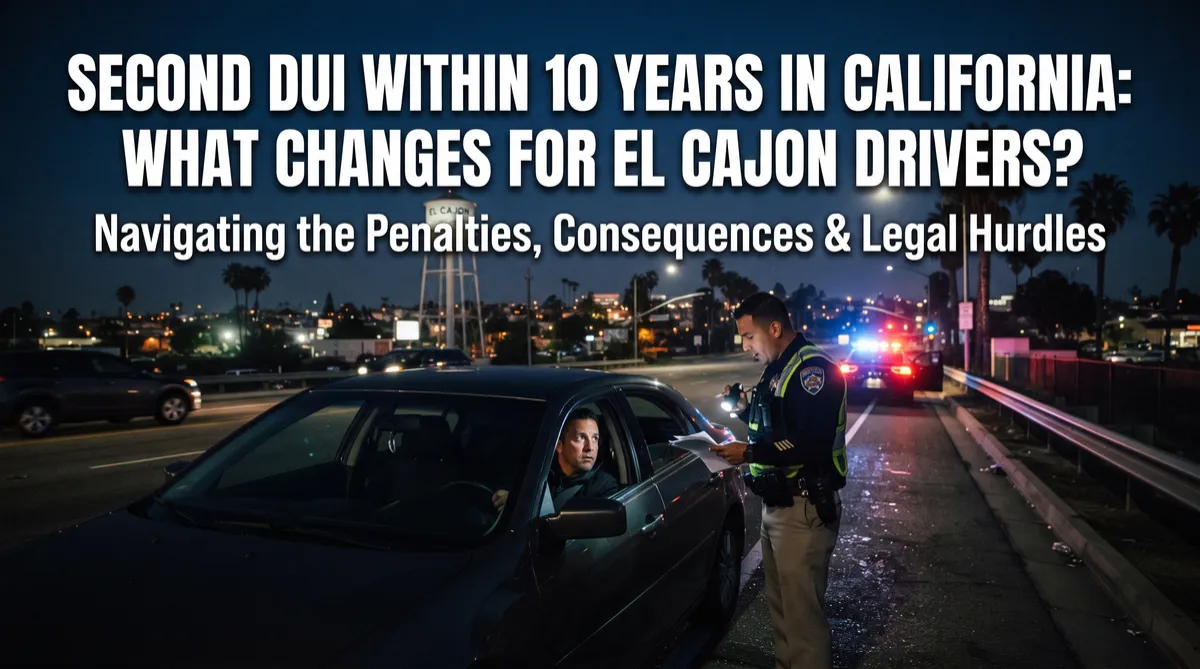
Second DUI Within 10 Years in California: What Changes for El Cajon Drivers?
A second DUI within 10 years in California carries significantly greater consequences than a first offense.
El Cajon drivers can face increased jail exposure, a longer DUI program, a two-year license suspension, mandatory ignition interlock requirements, and higher financial costs.
Key Takeaways:
• California generally uses a 10-year period when determining repeat DUI penalties.
• A second non-injury DUI carries substantially greater jail and license consequences.
• Alcohol-related second offenders generally face a one-year mandatory IID restriction.
What Counts as a Second DUI Within 10 Years in California?
A DUI is generally treated as a second offense when the new violation occurs within 10 years of a qualifying prior DUI-related conviction.
California Vehicle Code §23540 specifically includes prior convictions for DUI under §23152, DUI causing injury under §23153, and wet reckless convictions covered by §23103.5.
This means a prior case does not necessarily need to have ended with the word “DUI” on the conviction.
A prior wet reckless can also increase penalties if another DUI occurs within the 10-year period. (California Vehicle Code §23540) (Legislación de California)
For example, an El Cajon driver who resolved an earlier DUI as wet reckless may still face second-offense treatment after a new qualifying DUI.
The exact dates and prior court record should therefore be reviewed before assuming how prosecutors will classify the case.
What Are the Penalties for a Second DUI in California?
A second DUI increases both criminal penalties and mandatory treatment requirements.
Vehicle Code §23540 provides a statutory jail range of 90 days to one year and a fine between $390 and $1,000 for a qualifying second DUI conviction.
Actual custody terms can differ when probation is granted and depend on the sentence negotiated or imposed in the individual case.
California also requires a substantially longer DUI education program.
The California Department of Health Care Services states that second and subsequent DUI offenders must complete an 18-month multiple-offender program. The program includes alcohol and drug education, group counseling, individual interviews, and community reentry monitoring. (California DHCS — Driving-Under-the-Influence Programs) (DHCS)
Compare that with the standard three-month program commonly associated with many first offenses.
Other consequences may include:
• Probation
• Court assessments and fees
• Vehicle-related costs
• Increased insurance premiums
• SR-22 requirements
• Ignition interlock expenses
Aggravating circumstances can increase exposure further.
Examples include an accident, injuries, high BAC, chemical-test refusal, excessive speed, or a child passenger.
If the new DUI caused an injury, see our guide to DUI accidents and felony injury charges in El Cajon.
A second DUI is not simply a first DUI with a larger fine. California increases the consequences across jail, treatment, licensing, and restricted driving.
What Happens to Your License After a Second California DUI?
A second DUI creates more serious DMV consequences.
California DMV materials list a two-year license suspension following a second non-injury DUI conviction.
The DMV process can also begin before the criminal case ends.
After a DUI arrest, California's Administrative Per Se system can impose a separate administrative suspension. A driver generally has only 10 days from the arrest to request a DMV hearing. (California DMV — Driving Under the Influence) (DMV California)
That creates two separate proceedings:
Criminal case: Determines guilt, criminal penalties, and probation conditions.
DMV case: Determines administrative driving privileges.
Do not wait for the El Cajon Superior Court case to finish before addressing DMV deadlines.
A second offender may also need SR-22 proof, DUI-program enrollment, fees, and other documentation before obtaining restricted or restored driving privileges.
Is an Ignition Interlock Device Required After a Second DUI?
For an alcohol-related second DUI, an ignition interlock device is generally mandatory.
California's statewide IID program requires repeat alcohol-related DUI offenders to install an IID.
For a second non-injury DUI with one qualifying prior conviction within 10 years, the mandatory IID restriction is generally one year.
During the IID restriction, the driver may generally drive anywhere if the vehicle being operated has a functioning certified device.
To obtain an IID-restricted license, DMV generally requires:
• IID installation
• Proof of DUI-program enrollment
• SR-22 insurance proof
• Applicable DMV fees
The statewide IID program currently applies to qualifying offenses through December 31, 2032. (California DMV — Statewide Ignition Interlock Device Program) (DMV California)
Drug-only DUI cases can involve different IID rules.
Drivers should also understand that an IID does not erase the underlying DUI or automatically resolve every DMV suspension.
With a second DUI, protecting the driver's license becomes part of the defense from day one. Court and DMV deadlines move on separate tracks.
FREQUENTLY ASKED QUESTIONS
Q: Is a second DUI within 10 years a felony in California?
A: A second DUI without injury is generally prosecuted as a misdemeanor. However, the consequences are considerably more serious than those for many first offenses. Felony exposure can arise under different circumstances, including certain injury cases and qualifying prior felony DUI histories. The exact charges depend on the current incident and the driver's prior record.
Q: How much jail time can you get for a second DUI in California?
A: California law provides a statutory jail range of 90 days to one year for a qualifying second DUI conviction. Sentencing can work differently when probation is granted, and the actual custody requirement depends on the case, plea agreement, aggravating circumstances, prior history, and court orders.
Q: Does a wet reckless count as a prior for a second DUI?
A: It can. California law specifically recognizes qualifying wet reckless convictions when determining repeat DUI penalties within the 10-year period. A driver whose first DUI was reduced should not assume the old case disappears for future sentencing purposes. The prior court record should be reviewed carefully.
Q: Do I need an IID after a second DUI in California?
A: Generally, yes for an alcohol-related second DUI. A second non-injury offender with one qualifying prior conviction generally faces a one-year mandatory IID period under California's current statewide program. Drug-only cases and other circumstances can produce different requirements, so the DMV record and conviction should be reviewed individually.
Facing a Second DUI Charge in El Cajon?
A second DUI raises the stakes, but a prior conviction does not prove the new charge.
Howard Williams can challenge the current traffic stop, field sobriety testing, breath or blood evidence, BAC timing, chemical-test procedures, and DMV action.
The prior conviction should also be reviewed to determine whether prosecutors can legally use it to enhance the new case.
If you were arrested for a second DUI in El Cajon or elsewhere in East County, contact the Law Firm of Howard Williams for a confidential case review.
About Howard Williams
Howard C. Williams is the founder of The Law Firm of Howard Williams in San Diego, California. He earned his J.D. from Western Sierra Law School and has been admitted to practice in California since 2009. His practice covers personal injury — auto, motorcycle, truck and rollover collisions — along with criminal defense and Chapter 7 bankruptcy. He is a member of the San Diego County Bar Association, Consumer Attorneys of San Diego, and the National Association of Consumer Bankruptcy Attorneys.
