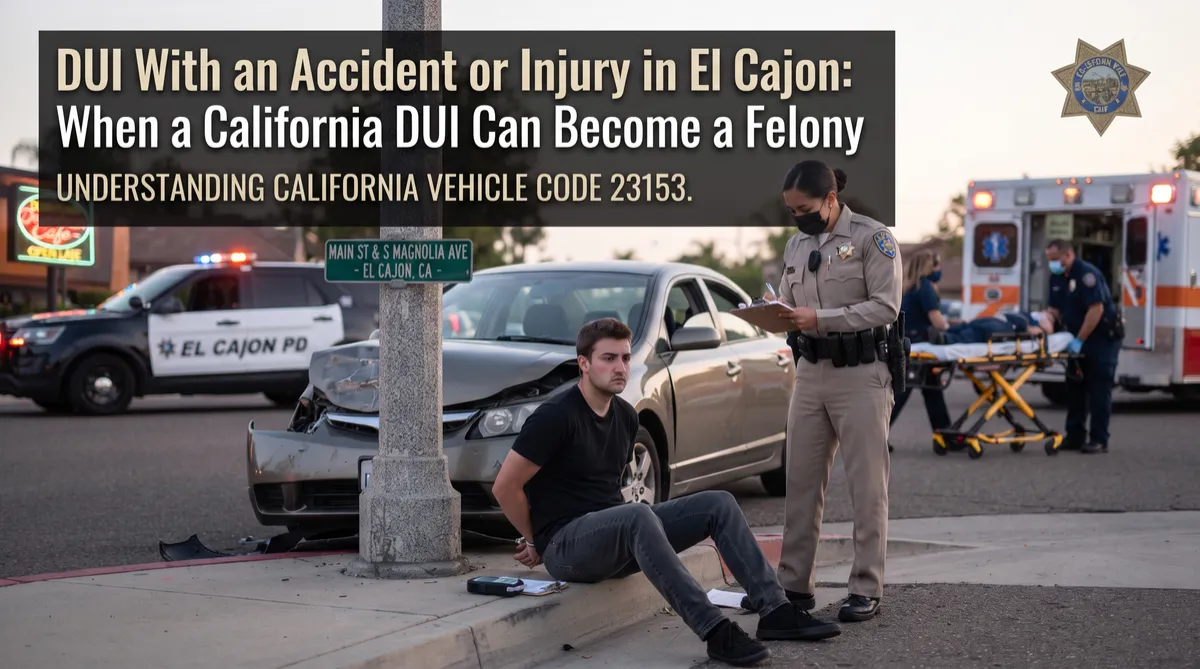
DUI With an Accident or Injury in El Cajon: When a California DUI Can Become a Felony
A DUI with an accident or injury in El Cajon can expose a driver to much more serious charges than a standard first DUI.
An accident alone does not automatically make DUI a felony. California prosecutors must establish additional elements, including an injury caused by the driver’s unlawful act or failure to perform a legal duty.
Key Takeaways:
• A DUI crash without injuries does not automatically become felony DUI.
• Vehicle Code §23153 requires bodily injury to someone other than the driver.
• Great bodily injury, multiple victims, and prior DUI convictions can significantly increase penalties.
When Does a DUI Accident Become DUI Causing Injury in California?
California Vehicle Code §23153 applies when a driver under the influence causes bodily injury while also committing an unlawful act or neglecting a legal driving duty.
Prosecutors generally must connect several parts of the case:
• The defendant drove while impaired or above the applicable BAC threshold.
• The driver committed another unlawful act or neglected a driving duty.
• That conduct contributed to the accident.
• Someone other than the driver suffered bodily injury.
Vehicle Code §23153 specifically requires the unlawful act or neglect to proximately cause another person’s injury. (California Vehicle Code §23153) (Legislación de California)
For example, prosecutors might allege that an impaired driver ran a red light and struck another vehicle.
The alleged traffic violation becomes important because DUI alone is not enough for a §23153 conviction.
Causation also matters.
A defense attorney may investigate whether another vehicle entered the intersection illegally, whether road conditions contributed to the collision, or whether the alleged injury resulted from another cause.
A crash investigation should therefore examine more than the BAC number.
Is DUI Causing Injury Always a Felony in California?
No. A first DUI causing injury can be prosecuted as either a misdemeanor or felony depending on the case.
California law allows punishment for a first §23153 conviction through state prison or county jail. Penal Code §17 explains how offenses carrying both felony and misdemeanor punishment can be treated as either classification. (California Vehicle Code §23554; California Penal Code §17) (Legislación de California)
Factors that can influence felony filing or sentencing exposure include:
• Severity of the injuries
• Number of injured victims
• Prior DUI-related convictions
• High BAC
• Dangerous driving
• Excessive speed
• Alleged drug impairment
• Facts showing significant traffic violations
A first conviction under §23153 carries a fine between $390 and $1,000. The statute also allows county jail from 90 days to one year or felony-level incarceration when prosecuted and sentenced as a felony.
Prior history can make the situation substantially more serious.
Vehicle Code §23566 requires state-prison punishment when a DUI causing injury occurs within 10 years of two or more qualifying prior DUI-related convictions.
The difference between misdemeanor and felony treatment can therefore depend on both the crash itself and the driver’s record.
What Happens When a DUI Crash Causes Serious Injuries or Multiple Victims?
Serious injuries and multiple victims can add years to a felony DUI sentence.
California Penal Code §12022.7 defines great bodily injury as a significant or substantial physical injury.
When a person personally inflicts great bodily injury during a felony, the general enhancement is an additional three consecutive years in state prison. (California Penal Code §12022.7) (Legislación de California)
Whether an injury qualifies depends on the facts.
Examples prosecutors may examine include substantial fractures, major internal injuries, severe head trauma, or other significant physical harm.
Multiple victims create another potential enhancement.
Vehicle Code §23558 provides an additional one-year state-prison term for each additional injured victim after a felony conviction, with a maximum of three such one-year enhancements. (California Vehicle Code §23558) (Legislación de California)
For example, a collision involving several passengers may create greater sentencing exposure than an accident involving one injured person.
These enhancements are not automatic simply because police describe the accident as serious.
The prosecution must properly allege and prove the facts supporting them.
Blood testing frequently becomes central after serious collisions, especially when a driver receives hospital treatment. Read our guide to DUI blood tests, warrants, and hospital draws in California.
In an injury DUI case, the defense must examine three separate questions: Was the driver impaired, what caused the crash, and what actually caused the injury?
How Can an El Cajon DUI With Injury Charge Be Challenged?
A DUI causing injury case can be challenged at several points because prosecutors must prove more than alcohol consumption.
The defense may investigate:
• Whether the driver was actually impaired
• Breath or blood testing accuracy
• Rising BAC
• Who caused the collision
• Whether another driver violated traffic laws
• Accident reconstruction evidence
• Witness statements
• Surveillance or dash-camera footage
• Whether the claimed injuries resulted from the collision
• Whether an injury qualifies for an enhancement
Imagine an El Cajon driver has alcohol in their system when another vehicle crosses into their lane.
If the other vehicle caused the collision, prosecutors may have difficulty proving the causation required under §23153.
The same applies when chemical testing creates questions.
A blood sample taken substantially after an accident may not establish the exact BAC at the time of driving. Collection, storage, laboratory procedures, and warrant issues may also require review.
Accident reconstruction can be equally important.
Vehicle damage, skid marks, traffic-camera footage, event-data recorders, road design, and witness accounts can help determine what actually happened.
The objective is not only to dispute the DUI allegation.
The defense may also challenge felony filing, injury enhancements, causation, or negotiate for a lesser charge when the evidence supports it.
A crash does not prove felony DUI. The prosecution still has to connect impairment, unlawful driving, causation, and injury.
FREQUENTLY ASKED QUESTIONS
Q: Is every DUI accident a felony in California?
A: No. A collision by itself does not automatically turn a DUI into a felony. DUI causing injury requires bodily injury to another person plus an unlawful act or neglected driving duty that proximately caused the injury. A DUI crash involving only property damage may still produce serious charges, but it does not automatically satisfy California’s DUI-causing-injury statute.
Q: Can a first DUI with injury be charged as a felony?
A: Yes. A first DUI causing injury can potentially be prosecuted as a felony or misdemeanor. The decision can depend on the injuries, accident circumstances, driving conduct, criminal history, and other facts. Serious injuries or aggravating circumstances can increase the likelihood of felony prosecution and additional sentencing allegations.
Q: What counts as great bodily injury in a California DUI case?
A: California defines great bodily injury as significant or substantial physical injury. Whether an injury meets that standard depends on its nature and severity. A great-bodily-injury allegation can substantially increase sentencing exposure in a felony case, so medical records and the actual extent of the injuries should be carefully reviewed.
Q: What happens if more than one person is injured in a DUI accident?
A: Multiple injured victims can increase the potential sentence after a felony DUI-causing-injury conviction. California law permits additional prison time for qualifying additional victims. The prosecution must properly allege and prove each injury supporting an enhancement, so the number of occupants alone does not automatically determine the final sentence.
Facing a DUI Accident or Injury Charge in El Cajon?
A DUI accident investigation can quickly become a felony case when another person reports injuries.
Howard Williams reviews the chemical testing, collision evidence, witness statements, police reports, medical evidence, causation, and potential sentencing enhancements.
Early investigation can also help preserve traffic-camera footage, vehicle data, photographs, and witnesses before evidence disappears.
If you were arrested after a DUI accident in El Cajon or elsewhere in East County, contact the Law Firm of Howard Williams for a confidential case review.
About Howard Williams
Howard C. Williams is the founder of The Law Firm of Howard Williams in San Diego, California. He earned his J.D. from Western Sierra Law School and has been admitted to practice in California since 2009. His practice covers personal injury — auto, motorcycle, truck and rollover collisions — along with criminal defense and Chapter 7 bankruptcy. He is a member of the San Diego County Bar Association, Consumer Attorneys of San Diego, and the National Association of Consumer Bankruptcy Attorneys.
