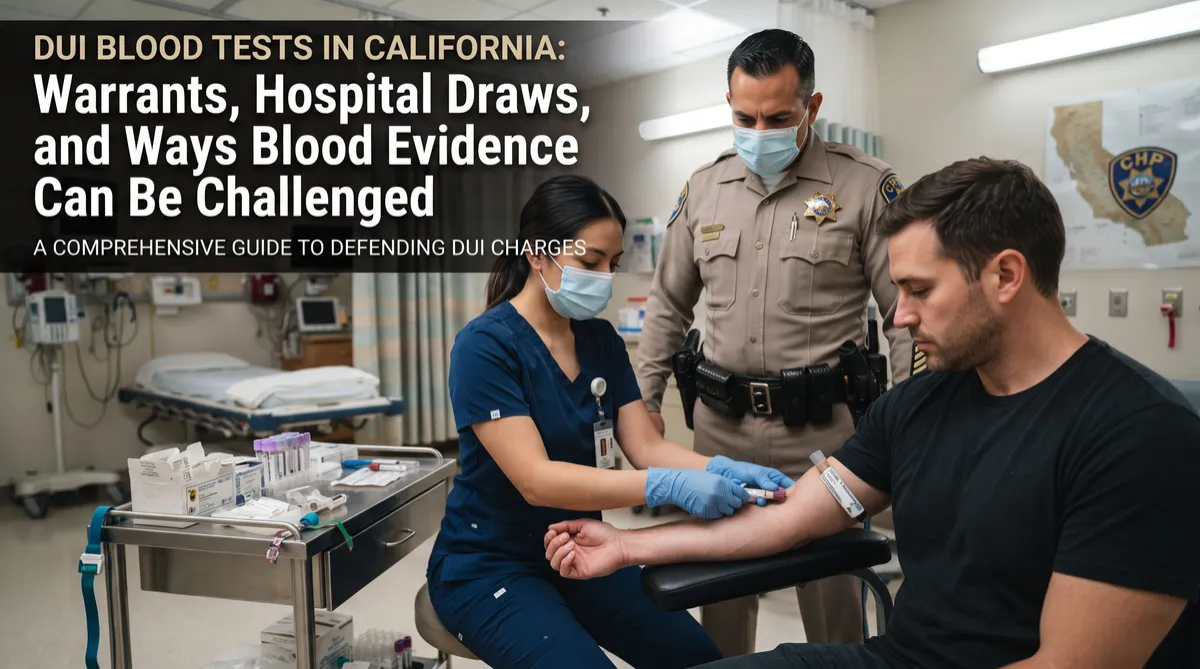
DUI Blood Tests in California: Warrants, Hospital Draws, and Ways Blood Evidence Can Be Challenged
DUI blood tests in California can provide powerful prosecution evidence, but a laboratory BAC result is not automatically beyond challenge.
Questions about warrants, consent, collection procedures, hospital treatment, sample handling, and laboratory analysis can affect whether blood evidence is admissible or persuasive.
Key Takeaways:
• California's implied-consent law applies after a lawful DUI arrest, but forced blood draws raise separate Fourth Amendment issues.
• Police can seek a blood-draw warrant after a driver refuses required chemical testing.
• Collection procedures, sample integrity, laboratory analysis, and timing can create defense issues.
When Can Police Request a DUI Blood Test in California?
California's implied-consent law applies after a lawful DUI arrest.
Vehicle Code §23612 states that a person who drives in California is deemed to consent to qualifying blood or breath testing after a lawful arrest for specified DUI offenses. Drivers arrested for alcohol DUI generally have a choice between blood and breath when both are available. Different provisions apply when drugs are suspected. (California Vehicle Code §23612) (Legislación de California)
This is different from a roadside Preliminary Alcohol Screening test.
A blood test is often used when:
• Drugs are suspected
• Breath testing is unavailable
• A driver chooses blood after arrest
• A collision requires hospital treatment
• Police obtain a blood-draw warrant
Refusing required post-arrest chemical testing can also create separate driver's-license and sentencing consequences.
However, implied consent does not mean police have unlimited authority to forcibly take blood without considering the Fourth Amendment.
That distinction becomes especially important when a driver refuses or cannot provide actual consent.
Do California Police Need a Warrant for a DUI Blood Draw?
Police generally need a warrant for a nonconsensual blood draw unless a recognized exception applies.
California Penal Code §1524 specifically allows judges to issue DUI blood-draw warrants when a driver refuses or fails to complete required testing and the blood will be collected in a reasonable, medically approved manner. (California Penal Code §1524) (Legislación de California)
Actual voluntary consent can also permit a blood draw.
Another possible exception involves genuine exigent circumstances.
However, alcohol naturally disappearing from the bloodstream does not automatically create an emergency allowing police to skip the warrant process.
A July 2026 California Court of Appeal decision reinforced this rule.
In People v. Castro, the court held that officers lacked sufficient exigent circumstances for a warrantless blood draw from an unconscious DUI suspect contacted at a hospital. The court emphasized that unconsciousness does not automatically eliminate the warrant requirement. (People v. Castro, California Court of Appeal, July 1, 2026) (Tribunales de California)
The circumstances matter.
Police may have stronger arguments for an emergency exception after a serious collision requiring officers to manage injuries, traffic, and other urgent responsibilities.
But prosecutors cannot rely on a blanket rule that every unconscious driver can be tested without a warrant.
What Happens When Blood Is Drawn at a Hospital After a DUI Crash?
A hospital blood draw can involve different evidence depending on why the blood was collected.
A hospital may draw blood for medical treatment.
Law enforcement may also arrange a separate forensic blood draw for DUI testing.
Those are not necessarily the same sample or laboratory test.
California law limits who may withdraw blood for determining alcohol content. Authorized professionals include physicians, registered nurses, certain laboratory professionals, certified phlebotomy technicians, and qualifying paramedics. The statute also requires law-enforcement-requested blood draws to occur in a reasonable manner. (California Vehicle Code §23158) (Legislación de California)
A defense attorney should determine:
• Who ordered each blood draw
• Why the sample was collected
• Who physically drew the blood
• When the draw occurred
• Which laboratory analyzed it
• Whether police obtained a warrant
• Whether the prosecution relies on medical testing, forensic testing, or both
Timing can become especially important.
A blood sample collected substantially after driving may not show the driver's exact BAC while behind the wheel.
Alcohol absorption can continue after the person stops driving.
A hospital location does not make blood evidence automatically valid. The defense still needs to examine why the blood was drawn, how police obtained it, and what the laboratory actually tested.
How Can DUI Blood Test Evidence Be Challenged?
A DUI blood result can be challenged by examining the entire process from collection through laboratory analysis.
California's forensic alcohol regulations establish procedures designed to preserve blood-sample integrity.
Among other requirements, blood collected for forensic alcohol analysis must use appropriate equipment. Alcohol or another volatile organic disinfectant should not clean the collection site. The sample must also be mixed with an anticoagulant and preservative. Remaining blood is generally retained so the defense can request a portion for independent analysis. (California Code of Regulations, Title 17 §1219.1) (Westlaw)
Potential defense issues include:
• Improper blood collection
• Questionable chain of custody
• Incorrect labeling
• Contamination
• Insufficient preservative or anticoagulant
• Storage problems
• Laboratory instrument issues
• Delayed testing
• Differences between hospital and forensic testing
• BAC rising between driving and the blood draw
The defense may also request an independent retest of the remaining sample.
A retest can help determine whether the government's reported result is reproducible.
Blood evidence involving drugs can require additional scrutiny because detecting a substance does not always answer when it was consumed or whether it caused impairment while driving.
This can become important with marijuana and some prescription medications. Read our guide to prescription medications and DUI charges in California.
A BAC number is the end of a laboratory process, not the beginning. A DUI defense should examine every step that produced that number.
FREQUENTLY ASKED QUESTIONS
Q: Can California police force me to take a DUI blood test?
A: Police may seek a warrant if a driver refuses a blood test. A nonconsensual blood draw generally requires a valid warrant or another recognized Fourth Amendment exception. California's implied-consent law can also create separate consequences when a lawfully arrested driver refuses required chemical testing.
Q: Do police need a warrant if I am unconscious after a DUI crash?
A: Unconsciousness does not automatically eliminate the warrant requirement. Whether police can obtain blood without a warrant depends on the specific circumstances and whether a valid exception applies. Emergency conditions at a serious crash scene may matter, but courts evaluate warrantless blood draws based on the facts of each case.
Q: Can hospital blood results be used in a California DUI case?
A: Hospital testing can become relevant evidence in a DUI case, depending on how the blood was collected and how prosecutors obtain and present the results. A defense attorney should determine whether the prosecution relies on medical blood testing, a separate law-enforcement forensic draw, or both.
Q: Can I have my DUI blood sample independently retested?
A: In many cases, yes. California procedures allow remaining forensic blood to be preserved so the defense can seek independent analysis when sufficient sample remains. A retest may confirm the government's result or identify differences requiring further investigation into collection, preservation, or laboratory procedures.
Was Blood Evidence Used in Your El Cajon DUI Arrest?
A laboratory report showing alcohol or drugs does not end the defense investigation.
Howard Williams can examine the warrant, hospital records, collection procedure, chain of custody, laboratory documentation, sample timing, and potential independent testing.
These details can reveal weaknesses affecting suppression motions, negotiations, or trial strategy.
If blood was taken after a DUI arrest in El Cajon or elsewhere in East County, contact the Law Firm of Howard Williams to discuss the evidence and possible defenses.
About Howard Williams
Howard C. Williams is the founder of The Law Firm of Howard Williams in San Diego, California. He earned his J.D. from Western Sierra Law School and has been admitted to practice in California since 2009. His practice covers personal injury — auto, motorcycle, truck and rollover collisions — along with criminal defense and Chapter 7 bankruptcy. He is a member of the San Diego County Bar Association, Consumer Attorneys of San Diego, and the National Association of Consumer Bankruptcy Attorneys.
