The “Rising Blood Alcohol” Defense: Why Your BAC at the Station Might Be Higher Than When Driving
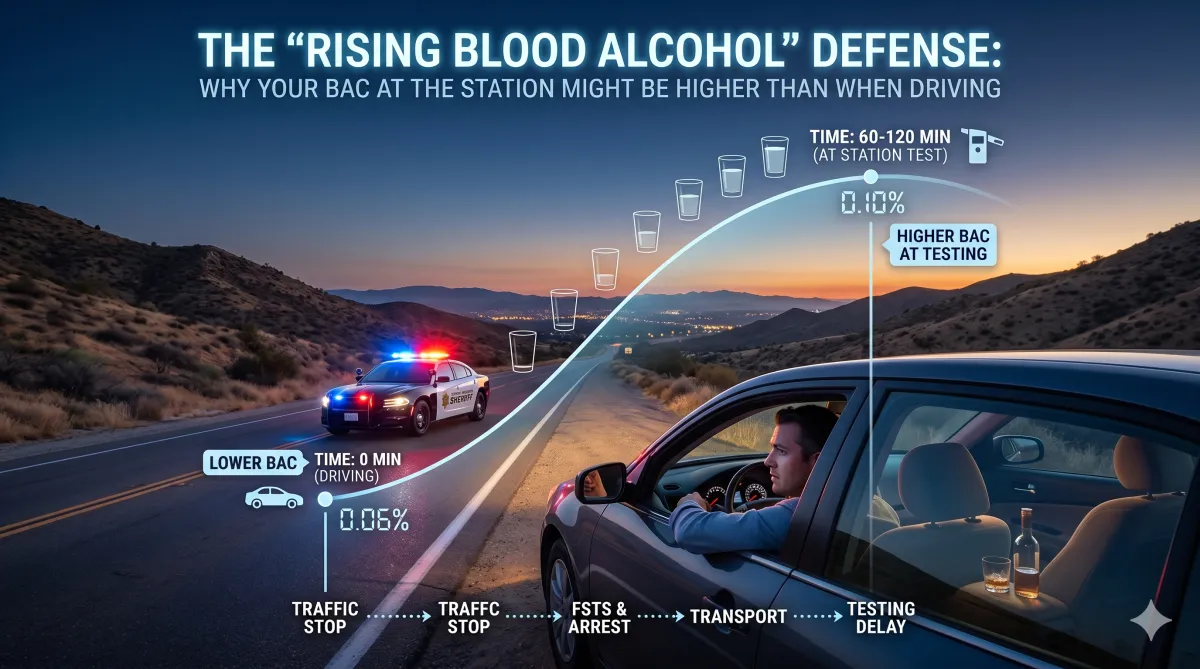
The “rising blood alcohol” defense is a scientific argument used in California DUI cases where a driver’s blood alcohol concentration (BAC) increases after they stop driving. In El Cajon and throughout San Diego County, this issue often arises when chemical testing occurs 30 to 120 minutes after a traffic stop, creating a gap between actual driving time and measured intoxication level.
Quick Answer
The rising blood alcohol defense argues that a driver’s BAC was lower while they were actually driving and increased afterward due to ongoing alcohol absorption. This can happen if alcohol has not fully entered the bloodstream at the time of driving, making station test results higher than the driver’s true BAC while on the road.
Key Takeaways
• BAC can continue rising after drinking stops
• Delay between driving and testing can affect results
• The defense challenges timing, not the accuracy of the test
What Is the Rising Blood Alcohol Defense?
The rising blood alcohol defense is based on alcohol absorption science.
After drinking, alcohol does not immediately reach peak concentration in the bloodstream. Instead, it passes through the stomach and small intestine over time.
This means a driver may still be absorbing alcohol after they stop driving, which can cause:
• Lower BAC while driving
• Higher BAC at the time of testing
Courts consider this a timing issue, not a testing error.
Why Does BAC Continue to Rise After Driving?
Alcohol absorption depends on several physiological factors.
Key variables include:
• Food in the stomach slows absorption
• Type and strength of alcohol consumed
• Body weight and metabolism rate
• Time elapsed since last drink
Because absorption is not instantaneous, BAC can peak 30 to 90 minutes after drinking ends.
How This Affects DUI Cases in El Cajon
In DUI arrests, officers typically observe driving behavior first and conduct chemical testing later.
In El Cajon cases, the timeline often looks like:
• Traffic stop on a roadway or freeway
• Field sobriety tests at the scene
• Arrest and transport to station
• Breath or blood test conducted later
That delay can create a measurable difference between driving BAC and tested BAC.
Why Prosecutors Still Rely on Station BAC
Prosecutors often argue that the chemical test reflects intoxication at or near the time of driving.
They rely on:
• Statutory presumptions under California DUI law
• Expert testimony on alcohol elimination rates
• Officer observations of impairment
However, these assumptions can be challenged with scientific evidence about absorption timing.
When the Rising BAC Defense Is Most Effective
This defense is strongest in cases where:
• The driver drank shortly before driving
• There is a clear timeline of recent alcohol consumption
• Testing occurred 45–120 minutes after driving
• No extreme driving behavior is documented
It is less effective when BAC is extremely high or drinking occurred long before driving.
BAC is not a fixed number in time. It is a curve that rises and falls.
How Defense Attorneys Use This Argument
A DUI defense lawyer may use toxicology and timing evidence to show:
• BAC was still rising after driving ended
• Test results do not reflect actual driving condition
• Police timeline is incomplete or inaccurate
Expert witnesses may reconstruct alcohol absorption based on:
• Drinking timeline
• Food intake
• Body composition
• Test timing
Frequently Asked Questions
Q: Does rising blood alcohol mean breath tests are wrong?
A: Not necessarily. Breath tests measure BAC at the time of testing, not while driving. The rising blood alcohol defense does not claim the machine is inaccurate. Instead, it argues that the result may not reflect the driver’s BAC at the time of driving due to ongoing alcohol absorption.
Q: How long does it take for BAC to peak after drinking?
A: BAC typically peaks between 30 and 90 minutes after drinking, but this varies based on food intake, alcohol type, and metabolism. This delay is what creates the possibility that a driver’s BAC was lower while operating the vehicle than at the time of testing.
Q: Can this defense get a DUI case dismissed?
A: It can, but it depends on the facts. The defense is most effective when timing evidence clearly shows rising absorption and when other evidence of impairment is weak. It is typically used to challenge the prosecution’s assumption about BAC at the time of driving.
Q: Do all DUI cases involve rising blood alcohol issues?
A: No. This defense is most relevant in cases involving recent drinking before driving and delayed chemical testing. In cases where drinking stopped long before driving, BAC is more likely to be stable or declining rather than rising.
Arrested for DUI With Rising Blood Alcohol Levels in San Diego?
If you were arrested for DUI in El Cajon or anywhere in San Diego County, the timing of your chemical test may be critical. A detailed review of your drinking timeline, arrest report, and BAC results can determine whether the rising blood alcohol defense applies to your case.
About Howard Williams
Howard Williams is an experienced El Cajon DUI defense lawyer focused exclusively on defending clients charged with DUI and DWI offenses in El Cajon, East County, and throughout San Diego County. He knows the local judges, prosecutors, and procedures at the El Cajon Superior Court, using that specific insight to challenge evidence and protect your future.
