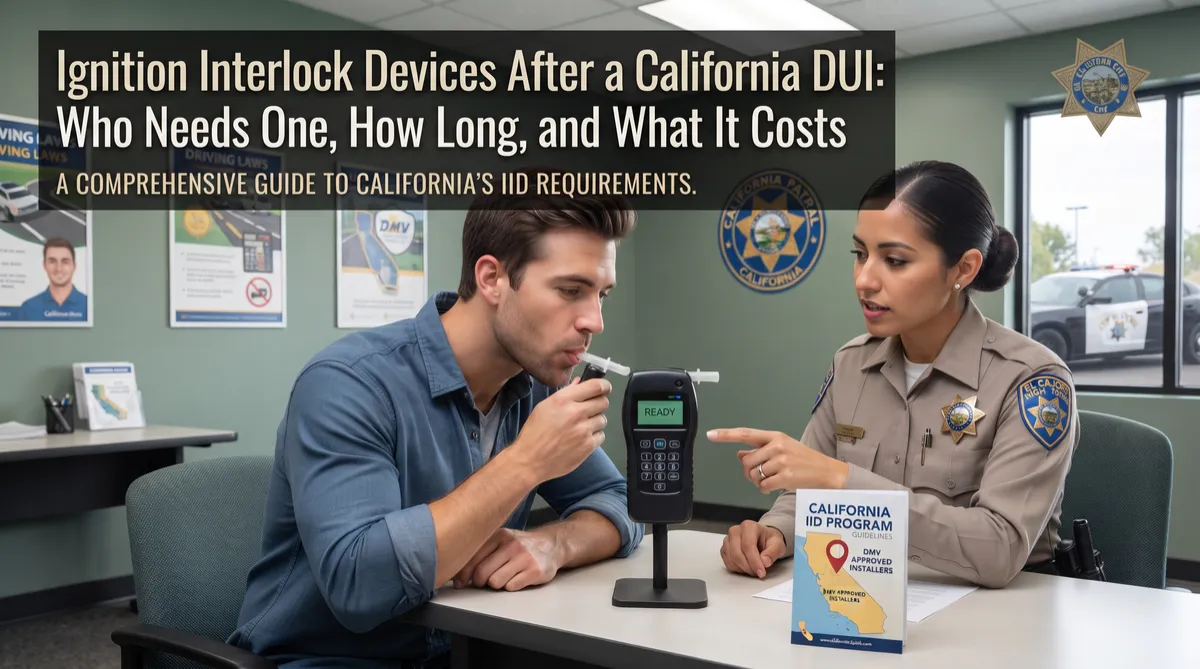
Ignition Interlock Devices After a California DUI: Who Needs One, How Long, and What It Costs
An ignition interlock device after a California DUI may be mandatory, court-ordered, or voluntarily installed to regain restricted driving privileges.
The requirement depends mainly on prior DUI convictions, whether someone was injured, and the specific DMV and court actions involved.
Key Takeaways:
• Repeat and injury-related DUI convictions generally trigger mandatory IID restrictions.
• A first non-injury DUI may involve an optional or court-ordered IID.
• California IID costs commonly include monthly device fees, installation, maintenance, and DMV fees.
Who Needs an Ignition Interlock Device After a California DUI?
California requires IIDs for repeat alcohol-related DUI offenders and drivers convicted of DUI causing injury.
Under the current statewide IID program, a first DUI with no injury does not automatically require installation. However, the court may order an IID for up to six months.
A first-time offender may also voluntarily install one to obtain an IID-restricted license instead of remaining fully suspended.
California's statewide program currently applies through December 31, 2032. (California DMV — Statewide Ignition Interlock Device Pilot Program) (DMV California)
An IID is generally mandatory after:
• A second alcohol-related DUI
• A third or subsequent alcohol-related DUI
• A DUI causing bodily injury
• Certain DUI-related vehicular manslaughter convictions
A wet reckless does not automatically require an IID. A judge can still order one in an appropriate case.
How Long Do California DUI Ignition Interlock Requirements Last?
Mandatory IID periods generally range from one to four years, depending on prior convictions and whether the offense involved injury.
California DMV currently lists these periods:
DUI History | Non-Injury DUI | DUI With Injury |
No prior DUI | No mandatory IID | 1 year |
1 prior | 1 year | 2 years |
2 priors | 2 years | 3 years |
3+ priors | 3 years | 3 years |
Prior felony DUI | 3 years | Up to 4 years |
The DMV counts qualifying prior DUI-related convictions occurring within the applicable 10-year period when determining these restrictions. (California DMV — Mandatory IID Installation Periods) (DMV California)
A first non-injury DUI works differently.
If the judge does not order an IID, an eligible driver may still choose an IID-restricted license. This option can allow driving anywhere as long as the vehicle has a functioning IID.
That can be more practical than a restricted license limited primarily to employment and DUI-program travel.
The exact restriction period can also depend on whether the driver faces an Administrative Per Se suspension from the arrest.
Read our El Cajon license suspension defense guide for more information about DMV consequences.
An IID can be a penalty, but in some first-offense cases it can also provide a faster route back to legal driving.
How Much Does an Ignition Interlock Device Cost in California?
IID costs vary by provider, vehicle, installation requirements, and how long the device remains installed.
A 2025 California Senate Public Safety Committee analysis estimated typical California IID costs at approximately $99 to $116 per month.
That amount may include or be affected by installation, servicing, maintenance, and required recalibration. Additional charges can apply for missed appointments, lockouts, removal, or noncompliance. (California Senate Public Safety Committee — AB 366 Analysis)
Mandatory IID cases can also involve a $103 DMV administrative service fee, plus other applicable reissue or restriction fees.
For example, six months at approximately $99 to $116 per month could place device-related costs around $594 to $696, before additional fees.
A one-year requirement could place the basic monthly cost around $1,188 to $1,392.
Actual quotes may differ.
California also provides reduced-cost assistance based on income.
The current fee schedule requires eligible consumers to pay:
• 10% of program costs at or below 100% of the federal poverty level
• 25% at 101%–200%
• 50% at 201%–300% or for qualifying CalFresh recipients
• 90% at 301%–400%
Drivers outside those categories generally pay the full program cost. (California Bureau of Automotive Repair — IID Reduced Fee Assistance) (Bureau of Automotive Repair)
Proof of income is required.
Before choosing an IID provider, compare the full program price—not only the advertised installation fee. Monthly service and removal costs can change the total substantially.
What Happens After an IID Is Installed?
An IID requires the driver to provide a breath sample before starting the vehicle.
If the device detects alcohol above its programmed threshold, the vehicle will not start.
The device can also request additional breath samples while the vehicle is being operated. California requires periodic maintenance and calibration, generally at intervals not exceeding 60 days.
A driver with an IID-restricted license may generally drive anywhere, provided the vehicle being operated has a functioning certified IID.
Compliance matters.
Problems can arise when a driver:
• Operates a vehicle without the required IID
• Attempts to bypass or tamper with the device
• Misses required maintenance
• Removes the IID before authorization
• Fails required breath tests
Time spent out of compliance may not count toward the required IID period.
Drivers usually must also meet other DMV reinstatement requirements, including enrollment in the required DUI program and proof of insurance.
FREQUENTLY ASKED QUESTIONS
Q: Does every first DUI in California require an ignition interlock device?
A: No. A first alcohol-related DUI without injury does not automatically require an IID under California's current statewide program. A judge may order one for up to six months. An eligible first offender may also voluntarily install an IID to obtain broader restricted driving privileges instead of serving a full suspension or using an employment-and-treatment-only restriction.
Q: Can I drive anywhere with an IID-restricted California license?
A: Generally, yes. An IID-restricted license can allow you to drive at any time and to any destination, provided the vehicle you operate has a properly installed and functioning certified IID. Other restrictions on your driving record can affect eligibility, so the DMV requirements should be reviewed before relying on this option.
Q: How much does an ignition interlock device cost each month in California?
A: Costs vary by installer and vehicle. A recent California legislative analysis estimated approximately $99 to $116 per month. Installation, maintenance, recalibration, removal, DMV charges, and noncompliance fees can increase the total. California also provides reduced-cost programs for qualifying lower-income drivers and some CalFresh recipients.
Q: Can I remove my IID as soon as the required time expires?
A: Do not remove an IID simply because you believe the required period has ended. DMV and court requirements must be satisfied first. Removing the device too early or failing to document compliance can delay reinstatement. Confirm that the restriction has been cleared before arranging removal through an authorized installer.
Do You Need an IID After an El Cajon DUI?
IID requirements depend on more than whether you were arrested for DUI.
Prior convictions, injuries, court orders, DMV suspensions, chemical-test results, and the type of restricted license can all change the answer.
Howard Williams can review both the criminal case and DMV action to determine whether an IID is mandatory, optional, or potentially avoidable through a successful defense.
If you were arrested for DUI in El Cajon or elsewhere in East County, contact the Law Firm of Howard Williams for a confidential case review.
About Howard Williams
Howard C. Williams is the founder of The Law Firm of Howard Williams in San Diego, California. He earned his J.D. from Western Sierra Law School and has been admitted to practice in California since 2009. His practice covers personal injury — auto, motorcycle, truck and rollover collisions — along with criminal defense and Chapter 7 bankruptcy. He is a member of the San Diego County Bar Association, Consumer Attorneys of San Diego, and the National Association of Consumer Bankruptcy Attorneys.
