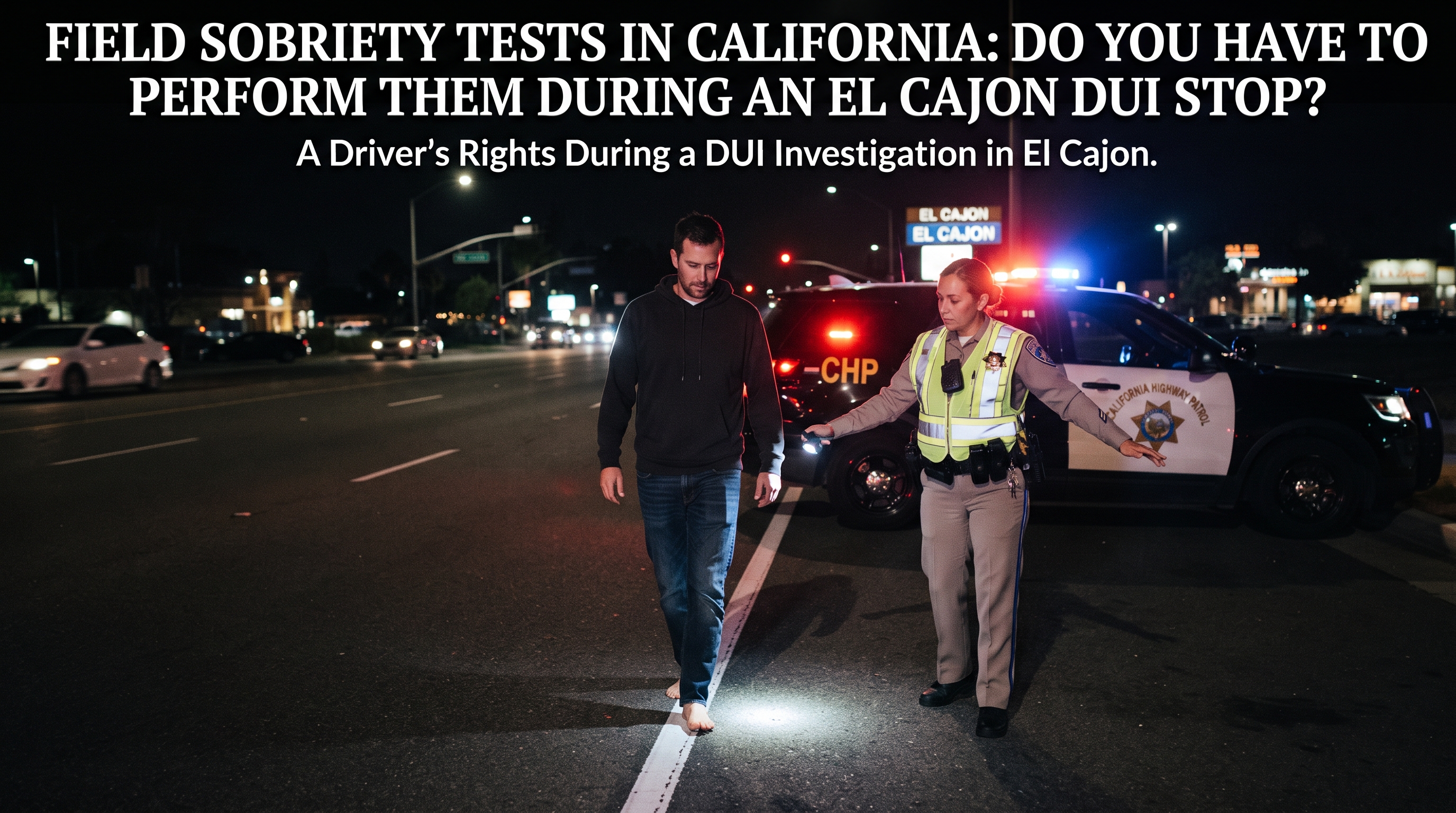
Field Sobriety Tests in California: Do You Have to Perform Them During an El Cajon DUI Stop?
Field sobriety tests in California are generally voluntary for adult drivers who are not subject to special testing rules.
Police use roadside exercises to collect evidence of impairment before making a DUI arrest. Whether you perform them can affect the evidence prosecutors later use against you.
Key Takeaways:
• Physical roadside field sobriety tests are generally voluntary for most adult California drivers.
• A roadside PAS breath test is different from a required post-arrest chemical test.
• Poor testing conditions, medical issues, instructions, and officer errors can affect FST evidence.
What Field Sobriety Tests Do California Police Use?
California officers use field sobriety tests to look for physical signs they believe indicate impairment.
The three standardized tests recognized in National Highway Traffic Safety Administration training are:
• Horizontal Gaze Nystagmus
• Walk-and-Turn
• One-Leg Stand
During the walk-and-turn, an officer may ask the driver to walk heel-to-toe along a line, turn, and return.
During the one-leg stand, the driver raises one foot and follows counting instructions.
Horizontal gaze nystagmus involves observing eye movement while the driver follows a stimulus.
NHTSA describes standardized procedures and emphasizes administering these tests under appropriate conditions. (NHTSA — Standardized Field Sobriety Testing Resources) (NHTSA)
Officers may also use nonstandard exercises such as counting, reciting portions of the alphabet, or finger-to-nose testing.
These exercises do not directly measure BAC.
Instead, officers use performance as one part of the DUI investigation.
This distinction becomes important because alcohol is not the only possible explanation for balance or coordination problems. Prescription medications, injuries, fatigue, and medical conditions can also affect performance.
Learn more in our guide to prescription medications and DUI charges in California.
Can You Refuse Field Sobriety Tests During an El Cajon DUI Stop?
Most adult California drivers can generally decline physical field sobriety tests.
California's implied-consent law focuses on chemical testing after a lawful DUI arrest. It does not create a general requirement that every adult driver perform roadside coordination exercises.
The situation is different with a Preliminary Alcohol Screening device.
California Vehicle Code §23612 classifies the PAS breath test as a type of field sobriety test used during an investigation. For drivers who are not subject to special rules, the statute requires officers to advise them of their right to refuse the PAS test. (California Vehicle Code §23612) (Legislación de California)
Declining physical FSTs does not guarantee you will avoid arrest.
An officer can still rely on other observations, including:
• Driving pattern
• Odor of alcohol
• Speech
• Red or watery eyes
• Statements about drinking
• Open containers
• Witness observations
• Other evidence gathered during the stop
For example, an El Cajon officer may believe probable cause exists based on driving behavior and observations even without completed field sobriety tests.
The key distinction is between declining a voluntary roadside exercise and refusing a legally required chemical test after arrest.
Field sobriety tests do not measure guilt. They create evidence, and that evidence should be examined against the conditions under which the tests were performed.
Is a Roadside Breath Test the Same as a Post-Arrest DUI Chemical Test?
No. A PAS breath test during a roadside investigation is legally different from post-arrest chemical testing.
This distinction causes significant confusion.
For most adult drivers, California Vehicle Code §23612 requires an officer using a PAS device to explain that the test assists the DUI investigation and that the driver has a right to refuse it.
However, special rules apply to some drivers.
California drivers under 21 are deemed to consent to PAS or other chemical testing when lawfully detained under the state's under-21 alcohol law. Drivers on DUI probation also face specific PAS testing requirements. (California Vehicle Code §§23136 and 23154) (Legislación de California)
After a lawful DUI arrest, the rules change again.
California's implied-consent statute provides that drivers lawfully arrested for specified DUI offenses are deemed to have consented to qualifying chemical testing. Refusing required testing can trigger license consequences and additional penalties. (California Vehicle Code §23612) (Legislación de California)
Think of the process as two separate stages:
Before arrest: Physical FSTs and, for most adult drivers, PAS testing are generally investigative.
After lawful arrest: California's implied-consent chemical-testing rules apply.
The biggest mistake is treating every DUI test as legally identical. Roadside exercises, PAS screening, and post-arrest chemical testing operate under different rules.
How Can Field Sobriety Test Evidence Be Challenged in an El Cajon DUI Case?
Field sobriety test evidence can be challenged by examining how the tests were administered and what else could explain the driver's performance.
Poor performance does not automatically prove intoxication.
A defense review may examine:
• Uneven pavement
• Poor lighting
• Traffic distractions
• Improper footwear
• Knee, ankle, hip, or back problems
• Age or balance conditions
• Fatigue
• Confusing instructions
• Officer demonstration errors
• Body-camera footage
Video can be especially important.
An officer's report may describe significant swaying or difficulty following instructions. Body-camera footage may show something different.
The defense can also examine whether the officer followed standardized testing procedures.
Testing conditions matter because these exercises depend on coordination, attention, and the officer's interpretation of specific clues.
Field sobriety evidence should therefore be considered alongside breath or blood results, driving behavior, video, medical explanations, and the legality of the initial traffic stop.
The impact can extend beyond the immediate case. Certain DUI convictions can affect employment or occupational licensing. See our guide to DUI and professional licensing in El Cajon.
FREQUENTLY ASKED QUESTIONS
Q: Do I have to walk a straight line during a California DUI stop?
A: Most adult drivers are generally not legally required to perform the walk-and-turn field sobriety test. You may decline the roadside exercise. However, refusing the test does not require the officer to release you. Police may still make a DUI arrest based on driving behavior, physical observations, statements, or other evidence.
Q: Can I refuse the one-leg stand test in California?
A: Most adult drivers can generally decline the one-leg stand and other physical field sobriety exercises. These tests help officers gather evidence during a DUI investigation. Declining them is different from refusing a required chemical test after a lawful DUI arrest, which can produce separate license and legal consequences.
Q: Can I refuse the roadside breathalyzer in California?
A: Many adult drivers can refuse a pre-arrest PAS breath test. However, important exceptions exist, including special rules for drivers under 21 and people on DUI probation. A PAS test should not be confused with post-arrest chemical testing under California's implied-consent law.
Q: Can failing field sobriety tests prove I was drunk?
A: Not by itself. Prosecutors may use poor FST performance as evidence of impairment, but many factors can affect the results. Injuries, balance problems, footwear, road conditions, fatigue, unclear instructions, and testing errors may provide alternative explanations. Video and officer training records can become important when challenging the results.
Were Field Sobriety Tests Used in Your El Cajon DUI Arrest?
Field sobriety tests can become an important part of the prosecution's case, but their conclusions are not automatically accurate.
Howard Williams reviews body-camera footage, officer instructions, testing conditions, medical explanations, breath or blood evidence, and the traffic stop itself.
If you were arrested for DUI in El Cajon or elsewhere in East County, contact the Law Firm of Howard Williams to discuss the evidence and possible defenses.
About Howard Williams
Howard C. Williams is the founder of The Law Firm of Howard Williams in San Diego, California. He earned his J.D. from Western Sierra Law School and has been admitted to practice in California since 2009. His practice covers personal injury — auto, motorcycle, truck and rollover collisions — along with criminal defense and Chapter 7 bankruptcy. He is a member of the San Diego County Bar Association, Consumer Attorneys of San Diego, and the National Association of Consumer Bankruptcy Attorneys.
