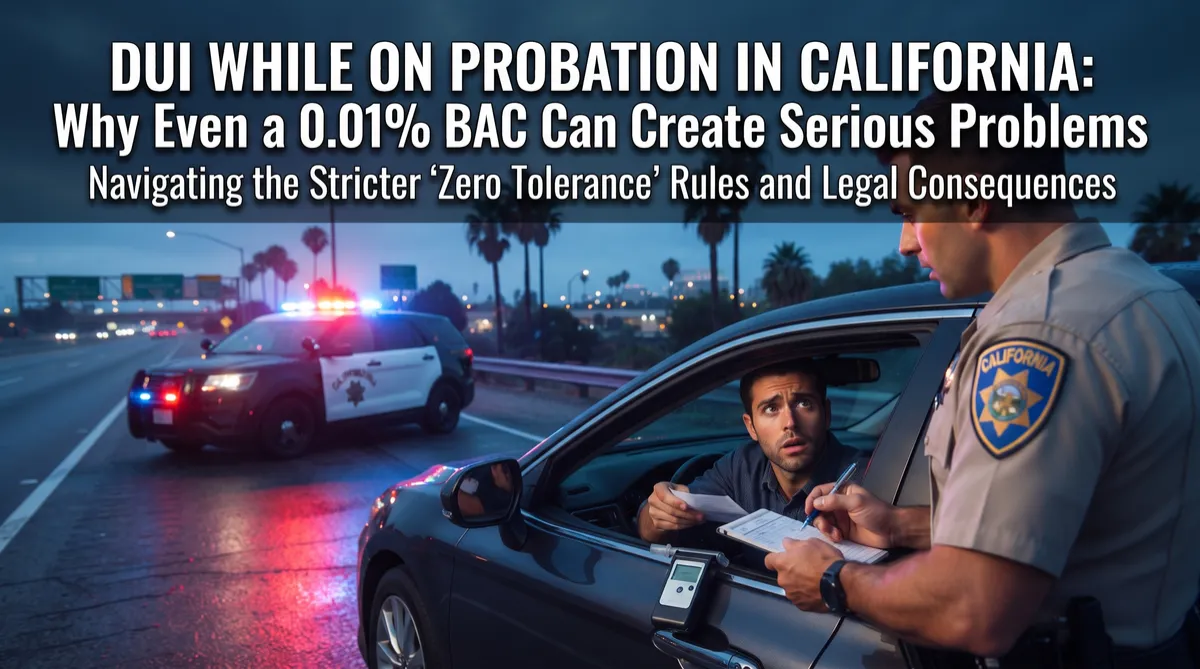
DUI While on Probation in California: Why Even a 0.01% BAC Can Create Serious Problems
A DUI while on probation in California creates stricter rules than those applying to drivers without a prior DUI conviction.
A driver on DUI probation cannot legally drive with a BAC of 0.01% or higher. Even a small amount of alcohol can therefore trigger DMV and probation consequences before BAC reaches the standard 0.08% DUI threshold.
Key Takeaways:
• California applies a 0.01% BAC limit while a driver is on DUI probation.
• Drivers on DUI probation face mandatory PAS testing rules during qualifying stops.
• A new DUI can trigger repeat-offender penalties in addition to probation consequences.
What Is California’s 0.01% BAC Rule While on DUI Probation?
California Vehicle Code §23154 makes it unlawful for someone on probation for DUI or DUI causing injury to drive with a BAC of 0.01% or higher.
That threshold is dramatically lower than the standard 0.08% per se DUI limit.
California DUI probation also normally includes a condition prohibiting the driver from operating a vehicle with any measurable alcohol in their blood. DUI probation generally lasts between three and five years. (California Vehicle Code §§23154 and 23600)
That means a driver on probation should not treat 0.08% as their practical legal limit.
A low BAC can create problems even when the driver does not appear impaired.
For example, an El Cajon driver on DUI probation who records 0.02% may avoid a standard §23152(b) charge based solely on BAC.
However, the 0.02% result can still trigger consequences under the probation-specific rule.
Alcohol may also come from unexpected sources, including some medications or products containing alcohol. The facts surrounding consumption and testing therefore matter.
Read our guide to prescription medications and driving under California DUI law.
Can a 0.01% BAC Cause a California License Suspension?
Yes. A 0.01% BAC while on DUI probation can trigger an Administrative Per Se license suspension.
Vehicle Code §13353.2 directs DMV to suspend driving privileges when someone on probation for DUI or DUI causing injury drives with a BAC of at least 0.01%.
California DMV separately confirms that the 0.01% threshold applies to drivers on DUI probation. The DMV administrative proceeding is separate from the criminal case. (California Vehicle Code §13353.2; California DMV — Alcohol and Drugs)
Because a driver currently on DUI probation necessarily has a qualifying prior conviction, a new administrative alcohol suspension can be substantial.
The driver generally has only 10 days after the arrest to request a DMV administrative hearing.
That hearing can examine issues such as:
• Whether the stop was lawful
• Whether the driver was actually on qualifying DUI probation
• Whether the test showed 0.01% or higher
• Whether the testing procedure was reliable
• Whether police reports and test records support the suspension
The DMV case should not be ignored while waiting for the El Cajon criminal case.
Winning or losing in court does not automatically decide every DMV issue.
For a driver on DUI probation, the critical BAC number is no longer 0.08%. California can begin imposing consequences at 0.01%.
Can You Refuse a Breath Test While on DUI Probation?
Drivers on DUI probation face stricter roadside testing requirements.
Under Vehicle Code §23154, a person on qualifying DUI probation is deemed to have consented to a Preliminary Alcohol Screening test or another chemical test when lawfully detained for a suspected probation-related alcohol violation.
The officer must have reasonable cause and must advise the driver that refusing or failing to complete the test can result in a license suspension or revocation.
Vehicle Code §13353.1 provides a one-year suspension for a first qualifying refusal. A later qualifying refusal within 10 years can lead to a two-year or three-year revocation depending on the driver's history. (California Vehicle Code §§23154 and 13353.1)
This is an important difference from many ordinary DUI stops.
Most adult drivers who are not on DUI probation can generally decline a pre-arrest PAS test.
A driver on DUI probation does not have the same protection when the statutory conditions apply.
The defense can still examine whether:
• Police had reasonable cause for the detention
• The detention itself was lawful
• Required warnings were given
• The driver actually refused
• The PAS device was functioning properly
• The test was administered correctly
Being on DUI probation changes the roadside testing rules. A PAS test that may be optional for another adult driver can become mandatory.
When Does Drinking on DUI Probation Become a New DUI?
A 0.01% result does not automatically mean prosecutors can prove a new standard DUI.
A new DUI under Vehicle Code §23152 generally requires proof that the driver was under the influence or drove with a BAC of at least 0.08% under the per se alcohol provision.
If prosecutors prove a new DUI while the prior DUI remains within California's 10-year lookback period, the new offense can be punished as a second DUI.
California law provides substantially increased penalties for qualifying second offenses, including greater jail exposure and additional licensing consequences. (California Vehicle Code §§23152 and 23540)
There can also be consequences in the original case.
California DUI probation requires no measurable alcohol while driving and prohibits refusing required post-arrest chemical testing.
If a driver violates certain probation conditions with a BAC over 0.04%, Vehicle Code §23600 directs the court to revoke or terminate probation and generally impose at least 48 hours in county jail for each violation, unless the court finds an unusual case where justice requires otherwise.
The defense therefore needs to separate three questions:
Was there a 0.01% probation-related violation?
Can DMV legally suspend the license?
Can prosecutors prove a new DUI?
Those are related issues, but they are not identical.
Breath-test accuracy, BAC timing, police observations, body-camera footage, and the legality of the traffic stop can affect the outcome.
FREQUENTLY ASKED QUESTIONS
Q: Can I get in trouble for a 0.01% BAC while on DUI probation?
A: Yes. California specifically prohibits driving with a BAC of 0.01% or higher while on probation for DUI or DUI causing injury. That low BAC can trigger DMV action and probation-related consequences even when it would not establish a standard 0.08% per se DUI by itself.
Q: Is 0.01% BAC automatically a second DUI in California?
A: No. A probation-related 0.01% violation and a new standard DUI are not the same thing. Prosecutors generally need additional evidence to establish a new DUI, such as actual impairment or a qualifying 0.08% BAC result. However, the 0.01% result can still cause serious license and probation consequences.
Q: Do I have to take a PAS breath test while on DUI probation?
A: California imposes special testing rules on drivers on DUI probation. When lawfully detained and the officer has reasonable cause to suspect a 0.01% violation, the driver is deemed to have consented to PAS or other qualifying chemical testing. Refusing or failing to complete the test can trigger separate license consequences.
Q: What happens if I get another DUI while still on probation?
A: A new DUI can create two problems. Prosecutors may pursue repeat-DUI penalties because the previous conviction falls within California's 10-year period. The original court may also address the conduct as a probation violation. Jail, license restrictions, DUI education, IID requirements, and additional probation conditions may follow depending on the case.
Accused of Driving After Drinking While on DUI Probation?
A low BAC does not mean the evidence should go unchallenged.
Howard Williams can review the stop, probation status, PAS procedure, breath or blood evidence, officer warnings, BAC timing, and DMV paperwork.
If prosecutors also allege a new DUI, the defense should address both the repeat-offense charge and the original probation case.
If you were stopped while on DUI probation in El Cajon or elsewhere in East County, contact the Law Firm of Howard Williams for a confidential case review.
About Howard Williams
Howard C. Williams is the founder of The Law Firm of Howard Williams in San Diego, California. He earned his J.D. from Western Sierra Law School and has been admitted to practice in California since 2009. His practice covers personal injury — auto, motorcycle, truck and rollover collisions — along with criminal defense and Chapter 7 bankruptcy. He is a member of the San Diego County Bar Association, Consumer Attorneys of San Diego, and the National Association of Consumer Bankruptcy Attorneys.
